The Value of the Practical Arts in Education and Society
In 2009 Jeremy Broun was invited to become a Fellow of The Royal Society of Arts and in 2011 wrote this article for their RSA Comment. The article was removed since his resignation from the RSA finding it not to support Arts & manufacturing (its original mission) but more focused on societal change with little interest in helping raise the status of the practical arts in education!


The value of the Practical Arts
in Education and Society
Mastery of technique is common across the arts. Whether you are a dancer, musician, or furniture maker, technique defines much of what you do. Technique has a magic; it has to be worked at and is admired and is something lasting to hand on. Particularly rooted in technique are the practical arts, traditionally called “craft” and the poor relation to art.

If you design a table that breaks or a chair that is uncomfortable and lacks any kind of aesthetic quality, it fails. The joy of using hands and mind creatively and purposefully and in working within these grounded and honest parameters can lead to a sense of well-being and foster the kind of innovation that the economy could ultimately benefit from.

I am not arguing a case for training up loads of carpenters and glass blowers or suggesting there is any one fix to the hugely complex problems facing us. But we do have an obligation to help young people develop their identity and potential and prepare them for the world. This is a messy task because children’s core values are already entrenched before they walk through the school gates.
School is not just about getting a place at university that will lead to a degree to become a bio-chemist that will lead to working in a restaurant as waiting staff. The quest to make university education the right of every child is political blindness when seven out of ten parents do not read out aloud to their young and one in ten can’t read properly by the time they get to secondary school.

Jeremy Broun teaches guitar making to school children
who have slipped below the system

Making craft 'respectable'
In the quest to make “craft” respectable, in our schools the subject has evolved from Handicraft to Design and Technology, which covers a range of resistant and non-resistant materials such as food, textiles, pneumatics, electronics and woodwork. This dilutes the purpose of the practical arts being physical (hugely important) whilst engaging the intellect. In overloading pupils (and their teachers) with such a broad curriculum in our panic about where we think the future jobs will lie and what children should know, many really valuable life skills are skated over.
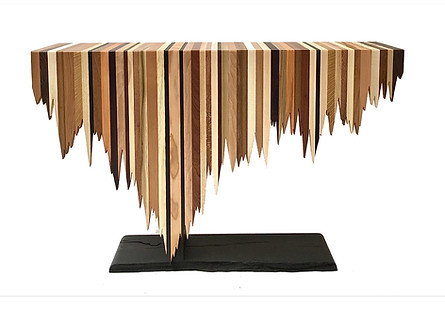
‘Craft’ is a confusing and socially divisive term and sociology certainly plays its part. Despite the low status of the practical arts in schools the opposite has happened in society where growing numbers of highly articulate upper middle class professionals (some are ex bankers) change career to become designer makers making expensive one-off pieces (eg furniture). Interestingly, in the past 40 years or so an underground movement (well, hardly anybody in Britain knows about it) of furniture designer makers leads the world in both quality and design and surpasses any previous era. Yet in our schools it is de-valued.
With an older generation enjoying the pursuit of retirement working within the luxury of garage workshops or garden sheds, a younger generation mostly in rented accommodation) is concerned about how they will pay off huge university debts whilst working as bar staff. We have a serious obligation to not only pass on these essential skills but encourage and enable young people to use their hands and minds creatively and find a way to do it.
Learning by doing
Children learn by doing and most enjoy making things. Attention Deficit Hyperactivity Disorder (ADHD) rarely occurs amongst children playing computer games or engaged in making things. Integrating designing with making is hugely empowering as the child is not just learning dexterous skills by merely copying crafted objects, but is challenged to make decisions about how things can be put together, what tools and materials to use (involving ethical choices) and how things can look.
Life skills
The practical arts are an ideal vehicle for fostering a wide variety of life skills such as perseverance, numeracy, a sense of history and accountability (Pic 1). There is no copy, paste and delete button or predictive text and patience is a key feature.
Not least the benefits of craft activity is in pacifying anti social behaviour. The therapeutic value of working wood in an absorbing way for many otherwise disengaged youngsters in the past could well be noted today.

Christine Meyer-Eaglestone veneered box

Britain leading the world in innovative furniture design.
Tom Vaughan 'Ribbon chair'. Definately not AI.
One way forward
Imagine engaging a broad spectrum of people who all predominantly use their hands in their work, to setup a small working group to develop a lowcost strategy for the next decade. Imagine a room filled with people such as a plumber, a designer jeweller, a motor mechanic, a brain surgeon, a seamstress, a dentist and so on..... ensuring there is just one of each to avoid comfort zones and include in the meeting a few random selected youngsters at sixth form level... and see what new thinking might emerge!
Jeremy Broun 2011
About Jeremy Broun:
Jeremy Broun wrote his first article for The Woodworker magazine in 1962 His experience in Education is vast, ranging from teaching woodwork to an Arab princess to ex heroin addicts achieving passes in City & Guilds Basic Woodwork. He has won numerous awards as a designer maker, author and film maker. He is currently working in a radical ebook called Design and Make in Wood based on intensive courses he has run since 1984. His 1993 book The Encyclopedia of Woodworking Techniques was revised in 2018. He has been a Fellow of The Society of Designer Craftsman since 1979 and from 2009 - 2013 was invited to serve as an inspector for The British Accreditation Council for Higher Independent Education. Currently he organizes The Alan Peters Furniture Award, a binnial online event.